Tiny Tim
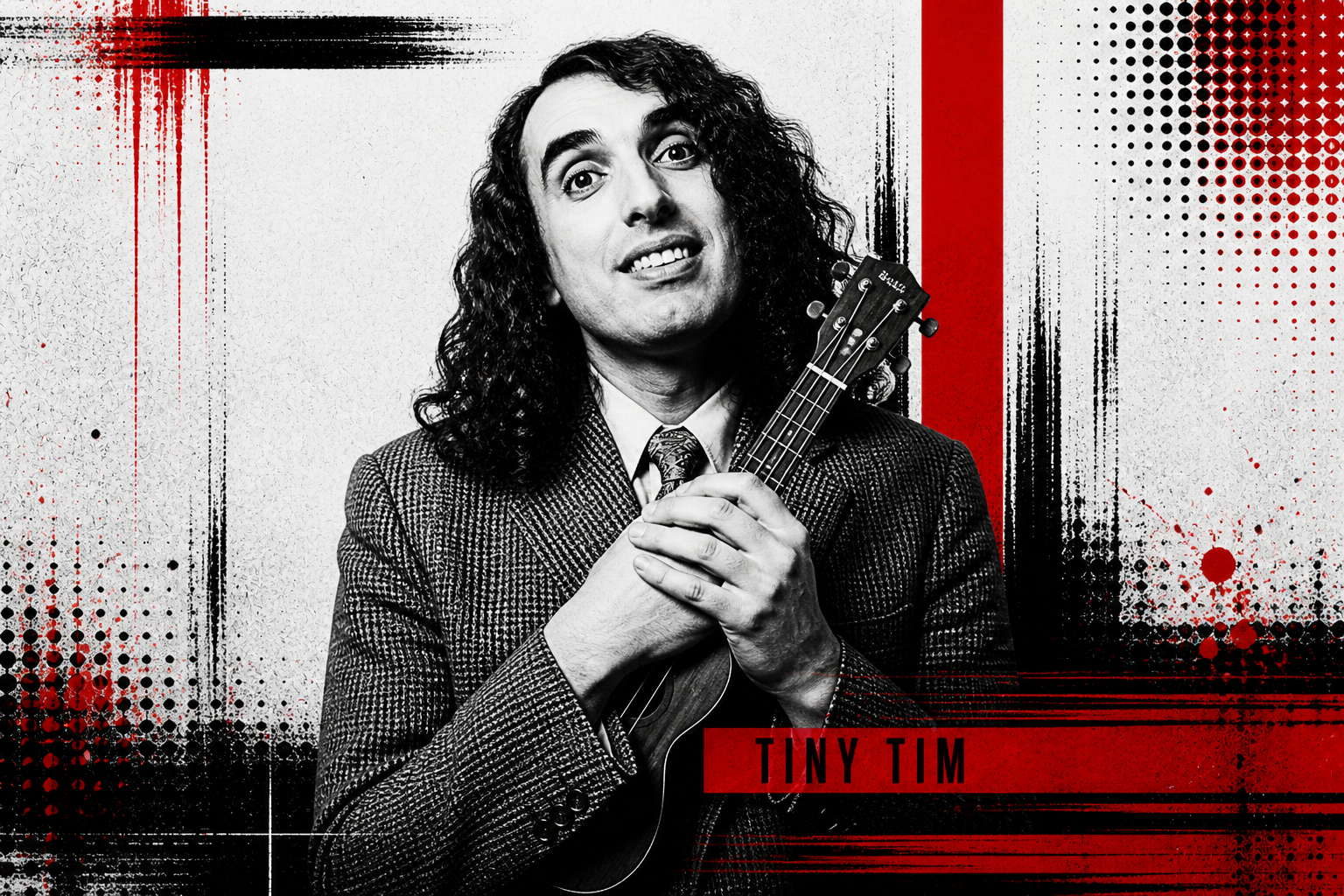
A falsetto that seemed to float somewhere between novelty and sincerity, paired with a ukulele and a deep love of early American popular music, defined the singular presence of Tiny Tim. Emerging into mainstream visibility in the late 1960s, he arrived not as a conventional pop artist, but as a performer whose entire identity challenged expectations. With his elongated features, vintage attire, and theatrical delivery, Tiny Tim blurred the line between parody and genuine musical devotion, leaving audiences unsure whether to laugh, admire, or simply watch in fascination.
Born Herbert Khaury, he developed an early obsession with the music of the early 20th century—vaudeville songs, Tin Pan Alley compositions, and forgotten ballads that had long since fallen out of popular rotation. Rather than treating these as relics, he revived them with a kind of reverence, often performing with meticulous attention to their original phrasing and style. His choice of material reflected a deep knowledge of musical history, positioning him less as a novelty act and more as a preservationist working through an unconventional lens.
His breakthrough moment came with “Tiptoe Through the Tulips,” a song that became inseparable from his image. Delivered in his distinctive falsetto, the track felt both whimsical and unsettling, its sweetness amplified to an almost surreal degree. The performance captured the essence of his appeal: something rooted in innocence yet presented with an intensity that made it impossible to ignore. Appearances on television, particularly on The Tonight Show Starring Johnny Carson, brought him into millions of homes, where his persona became a cultural talking point.
Beyond the surface, Tiny Tim’s work revealed a complex relationship with performance and identity. While many viewed him as eccentric or comedic, there was a clear intention behind his choices. His use of falsetto, his repertoire, and his visual presentation all contributed to a cohesive artistic statement—one that rejected contemporary trends in favor of something entirely his own. In a decade defined by transformation in music and culture, he stood apart by moving in the opposite direction, drawing from the past rather than the present.
His highly publicized marriage to Miss Vicki, broadcast live on television, further cemented his place in popular culture, turning a personal moment into a media spectacle. This event reflected the broader fascination with his persona, where the boundaries between his private life and public image became increasingly blurred. Yet even amid the attention, his focus on music remained consistent, continuing to perform and record with the same dedication to his chosen style.
As the cultural landscape shifted in the 1970s and beyond, Tiny Tim’s mainstream visibility declined, but his commitment to performance did not. He continued to appear in smaller venues, maintaining a connection with audiences who appreciated his uniqueness and his deep musical knowledge. In these settings, the theatrical aspects of his persona often gave way to a more direct engagement with the music itself, revealing a performer who remained deeply invested in his craft.
His legacy occupies a space that resists easy categorization. He has been described as a novelty act, a cult figure, and a musical historian, yet none of these labels fully capture the scope of his work. What remains clear is that he operated outside conventional frameworks, creating a body of work that feels both tied to a specific moment and entirely separate from it. His influence can be seen in artists who embrace eccentricity and individuality as central components of their identity.
Tiny Tim’s recordings and performances continue to evoke a sense of curiosity and intrigue, inviting listeners to reconsider their assumptions about authenticity, performance, and musical value. His work challenges the idea that sincerity must conform to expectation, demonstrating that devotion to an art form can take many shapes. In that sense, his career stands as an exploration of how far an artist can push beyond the boundaries of convention while remaining true to a personal vision.
There is also an underlying sense of vulnerability within his performances, where the exaggerated qualities of his voice and persona coexist with moments of genuine emotion. This duality creates a tension that gives his work lasting resonance, encouraging listeners to look beyond surface impressions and engage more deeply with the intent behind the presentation.
Tiny Tim remains a figure defined by contrast—past and present, humor and sincerity, spectacle and scholarship. His place in music history is not built on fitting into a movement or genre, but on standing apart from them entirely. In doing so, he created something that continues to be discussed, revisited, and reinterpreted, long after the era that first brought him into the spotlight.